Headaches that won’t go away, a stiff and achy neck… all these might just sound like side effects of daily stress and lifestyle problems. But this has been going on for days, and you are still unable to pinpoint the issue; then, chances are you might be suffering from TMJ disorder.
At Smile Masters and Jaw Joint Matters in Bandra West, Mumbai, we meet patients every week who are shocked to discover that their long-standing headaches are linked not to migraines or stress, but to a condition called TMJ disorder.
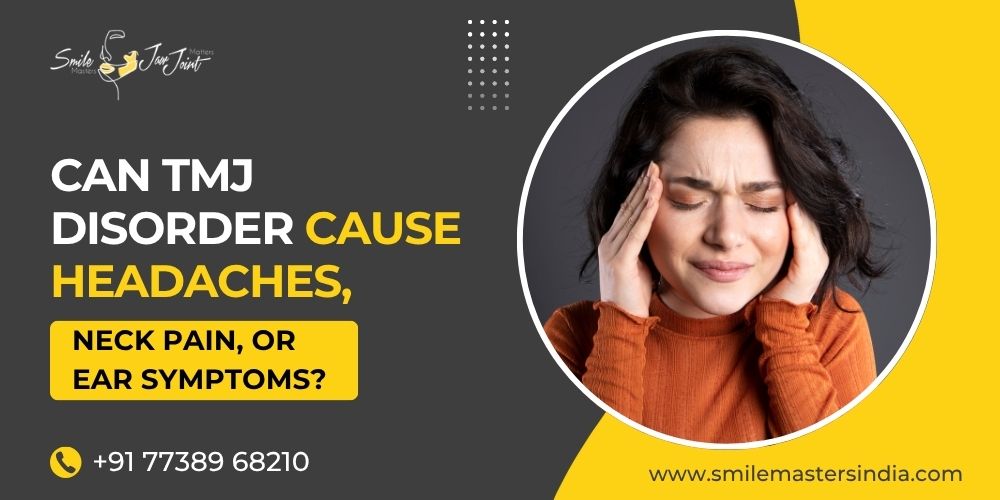
Your TMJ (temporomandibular joint) may be small, but its role in head and facial function is massive. It's the hinge connecting your jaw to your skull, and it's involved in chewing, speaking, yawning, and even facial expressions.
When this joint becomes inflamed, misaligned, or overused, it can create a ripple effect of pain that reaches far beyond the jaw itself. And one of the most commonly overlooked symptoms?..... Headaches.
While the exact mechanism can vary from person to person, most TMJ-related headaches are caused by a combination of:
The muscles that control your jaw don't work in isolation. They're part of a broader network of facial and cranial muscles, many of which are also responsible for supporting your head, neck, and upper face.
When the jaw muscles are overworked—say, from grinding your teeth at night or clenching during the day—they begin to refer pain to nearby regions. Think of it as a chain reaction: jaw tension spreads to the temples, forehead, or even the back of the head, mimicking a tension-type or migraine headache.
The trigeminal nerve is a major sensory nerve of the face. It also innervates the TMJ. If the joint is inflamed or irritated, signals may be misfired or amplified, leading to what feels like a nerve-triggered headache.
This explains why many TMJ patients describe their pain as:
A deep ache behind the eyes
Throbbing in the temples
A sense of pressure on one side of the head
Sound familiar?
If your bite is uneven or your joint alignment is off, the TMJ can compress unevenly, creating localized inflammation. Over time, this pressure can translate into discomfort that radiates to the sides or base of the skull—classic headache zones.
It's not "in your head." It's in your jaw, projecting upward.
Before jumping to conclusions, let's play detective for a moment. See if any of these apply to you:
Do your headaches tend to start after chewing or speaking for long periods?
Does your jaw click or pop when you open your mouth wide?
Do you clench your teeth when stressed or sleeping?
Does your headache feel worse in the morning or after chewing tough foods?
Have you tried migraine medications with little or no relief?
If you nodded "yes" to more than two of these, it's worth getting your jaw joint evaluated.
One of the biggest frustrations TMJ patients face is that their headaches don't respond to conventional treatments. They go from doctor to doctor, collecting prescriptions—only to find that the pain always returns.
Here's what we often see misdiagnosed:
Chronic tension headaches that are muscle referral from clenching.
One-sided migraines that are triggered by jaw joint misalignment.
Cluster headaches that are, in fact, nerve-related TMJ flare-ups.
It's a tricky puzzle—until someone checks the jaw.
Let's say you have a mild headache here and there. Not a big deal, right? Maybe not today. But leaving a TMJ issue untreated can lead to:
Worsening pain and frequency
Jaw locking or restricted opening
Tooth wear from nighttime grinding
Neck and shoulder involvement (a topic for another blog!)
Early diagnosis can spare you from years of discomfort and unnecessary medications.
At Smile Masters and Jaw Joint Matters, our headache-focused TMJ evaluation involves the following:
We'll ask about headache frequency, timing, and triggers—especially about jaw movement, chewing, or posture.
We gently examine the jaw, temple, and neck muscles to pinpoint tension spots that may be causing referred pain.
We assess how your teeth fit together, whether your bite is even, and how your jaw moves—looking for deviations, popping, or asymmetry.
If the pain persists or remains unresponsive, a CBCT scan or MRI may be recommended to rule out joint damage or inflammation.
If we suspect nighttime clenching, stress-related habits, or bruxism, we'll suggest ways to monitor or correct them, including bite splints or behavioral therapy.
You don't need to live on painkillers forever. Once the root cause is identified about “Can TMJ Disorder Cause Headaches, Neck Pain, or Ear Symptoms?”:
Custom occlusal splints (nightguards)
Muscle relaxants or anti-inflammatory meds
Physiotherapy and posture correction
Bite correction (if required)
Stress management techniques
Each treatment is customized to your specific pattern of pain and dysfunction.
Patients from all over Mumbai, other Indian cities, and even abroad trust us because of our:
Led by Prof. Dr. Moez Khakiani, our team performs a layered diagnosis, including:
TMJ-specific case history forms
Clinical muscle and joint palpation
Bite and occlusion analysis
Range of motion assessment
Advanced imaging (MRI or CBCT, if required)
Postural and airway evaluations
Blood tests for systemic causes
Online Consultation- We understand that travel may not be feasible for everyone. That's why we offer consultations online.
Review of all reports and history
Guided self-assessment over Zoom
Diagnosis discussion and treatment roadmap
Honest, clear answers to your concerns
At our clinic, we’ve met patients who’ve tried every pill, every scan, every specialist—and still left with more questions than answers. Until they asked one: Can TMJ Disorder Cause Headaches, Neck Pain, or Ear Symptoms? The moment we shifted focus to the jaw, everything changed. With a jaw-first approach, many walked out not just with answers—but with hope.
If your head is pounding and you've run out of reasons why, let us help you connect the dots. At Smile Masters and Jaw Joint Matters, Bandra West, Mumbai, we combine advanced diagnostics with personalized care to uncover the real reason behind your pain.